Technology
AI, Power Demand and the Talent Shift in Commodity Trading


AI is changing North America’s commodities landscape in two key ways:
For traders, AI is becoming both a market driver and a tool for decision-making. Data centre growth is feeding into electricity demand, grid pressure, gas-fired generation, renewable procurement and critical metals exposure, while trading firms are using AI and advanced data tools to improve forecasting, execution and risk management.
The firms that benefit will not necessarily be those that spend the most on technology. They are more likely to be those that build teams able to connect physical market knowledge with data, coding, risk and commercial judgement.
The energy impact of AI is now a live trading issue, particularly as the scale of expected demand growth becomes clearer.
The International Energy Agency has said the United States and China are expected to account for nearly 80% of global growth in data centre electricity consumption to 2030. In the US, data centre electricity use is expected to increase by around 240 TWh compared with 2024 levels.
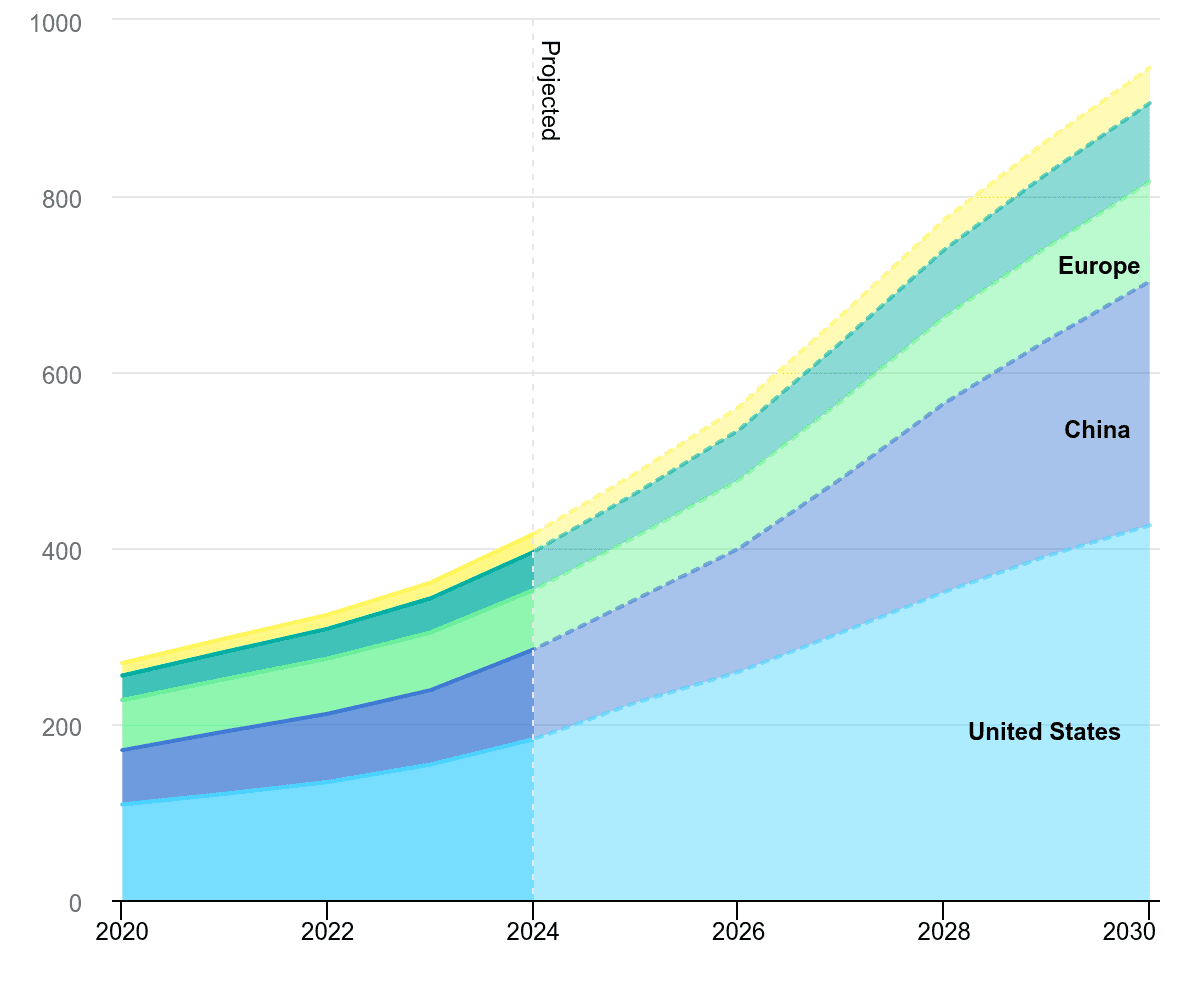
That demand is already changing North American power and gas markets. S&P Global reported that Dominion Energy Virginia had received 40.2 GW of data centre power connection requests by February 2025, up from 21.4 GW in July 2024. For traders, this affects more than long-term planning, with implications for price curves, congestion risk, generation mix, capacity markets and the value of flexible supply.
This is highly relevant for funds and trade shops. Power, gas and emissions desks are being asked to interpret AI-driven demand growth while also factoring in grid delays, local opposition, permitting, renewable availability and the response from utilities and technology firms.
Inside commodity firms, AI is being used to process larger volumes of information at greater speed. Weather data, vessel tracking, satellite imagery, grid data, plant outages, policy announcements and alternative datasets can all feed into models that support trading decisions.
Yet commodities remain difficult to automate because physical markets do not always behave like clean datasets. Storage, transport, refinery issues, crop conditions, pipeline constraints and political decisions can all change the meaning of a signal. AI is therefore unlikely to replace experienced traders or analysts, but it can help them identify patterns, test assumptions and respond faster.
A recent report highlighted that that commodity traders increased IT costs and investments by 47% between 2018 and 2023, with IT headcount also rising – suggesting that technology is now being increasingly considered a part of how trading firms compete, instead of a back-office function.
The harder question is whether the talent market can support this shift. Funds and trade shops need people who understand physical commodities and can also work with coding, data engineering, risk and market structure, however, the pool of talent with that combination remains limited.
A power analyst who understands interconnection queues, grid congestion and weather risk is valuable, as is a data engineer who can structure complex market data. The greater need is for people who can:
North America has deep pools of trading, risk and analytics talent in Houston, New York, Chicago, Calgary and other commodity centres. Those cities also sit within a wider hiring market where funds, banks, utilities, infrastructure investors and technology firms are competing for similar skills.
As AI raises the value of data-rich trading, compensation pressure is likely to increase for hybrid profiles. Funds and trade shops may need to review how they assess candidates, with traditional commodity experience still important, but technical fluency, adaptability and the ability to work across functions becoming more central.
Many trading firms still organise teams around desks, products or regions. Whilst that structure can support accountability, AI-enabled trading requires closer links between traders, analysts, quants, engineers, compliance and risk.
If engineers sit too far from the desk, tools may fail to reflect how markets actually trade. If traders use AI outputs without proper challenge, firms may take risks they do not fully understand, and if compliance and risk teams are brought in too late, technology can move faster than governance.
The stronger model is likely to be more integrated, with traders and analysts defining the commercial questions, data engineers ensuring the inputs are reliable, quants testing the models, risk teams assessing exposure and compliance teams keeping AI use explainable and controlled.
AI will increase demand for commodity specialists who can think beyond one product or function. Power traders will need to understand data centre demand and gas supply, while gas desks will need to understand power burn and LNG flows. Metals analysts will need to track grid build-out, copper demand and technology supply chains, and risk leaders will need stronger technical literacy.
For funds and trade shops, the next phase of competition will depend on the quality of both technology and talent. Firms that bring commercial, technical and risk expertise together will be better placed to trade the AI power theme and use AI inside their own organisations.
Proco Group works with commodities businesses across North America and global markets to identify, assess and secure hard-to-find talent across trading, analytics, risk, technology and leadership roles. To discuss how AI and technology are affecting your talent requirements, please get in touch.
–
Kati Greenall
Managing Partner | North America